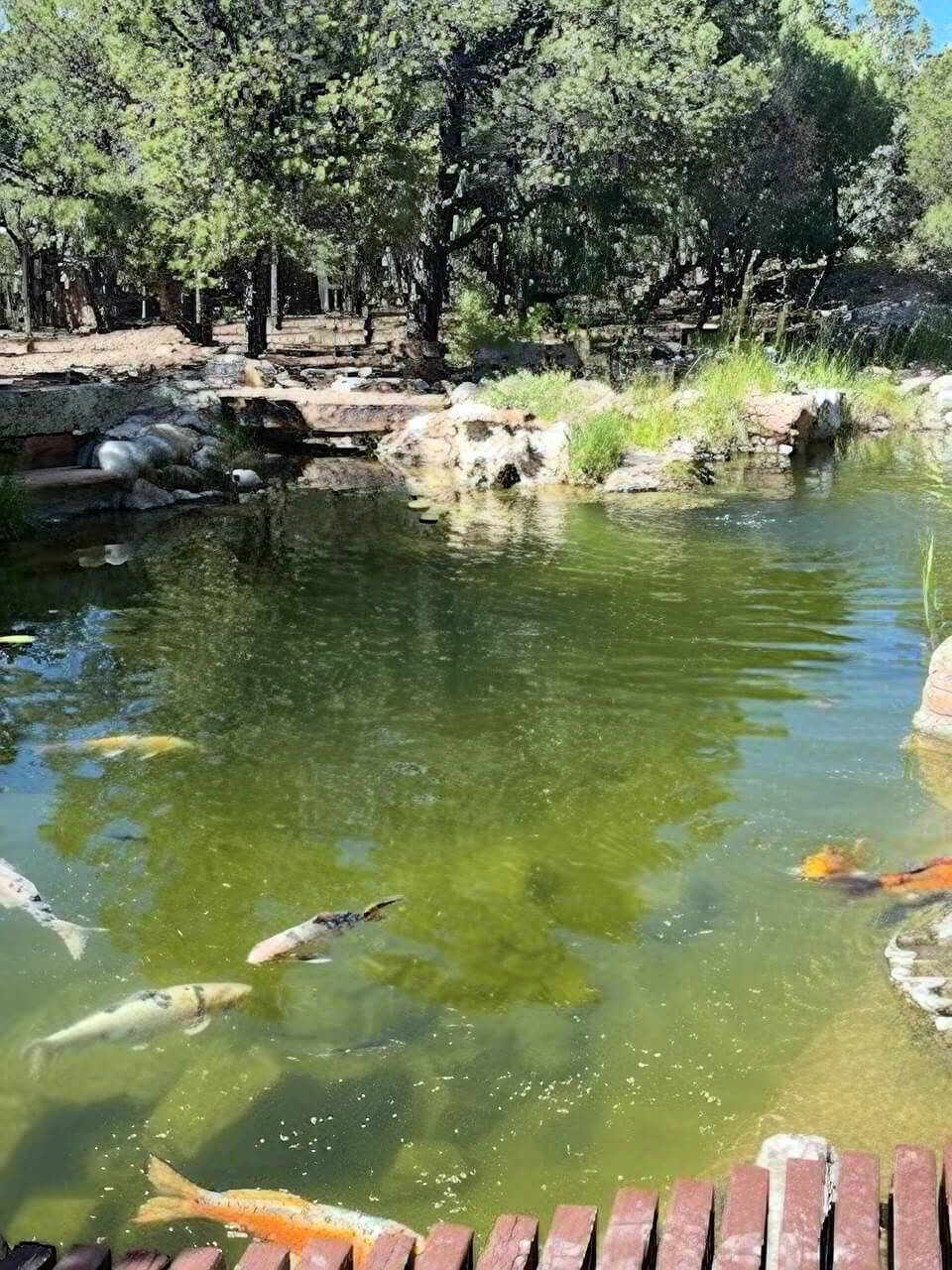
 Some years ago a man I was in love with at the time persuaded me to have a large fish pond dug near my studio. I think it was his attempt to be part of my necessarily solitary life there; like other such attempts, it failed—and now I’m left with the fish pond!
I live in the high desert. Water here is precious, to be measured by the drop as the aquifer sinks lower and lower, drained by overdevelopment and agriculture. Nobody, including me, has the right to a large fish pond. Even with recirculated water, too much is lost to evaporation.
The pond holds perhaps twenty Koi, from the large multicolored ones to the next generation of babies, fingerlings mostly black but with a few tinted silver and gold. Soon, there will be too many fish for the pond and I will join the many owners trying to give away surplus Koi. But since no one is foolish enough to build a large fish pond now, there are few takers—and certainly no one will buy them.
What is the moral of this little story? That in love we are all blind?
That seems downright petty.
I think instead my pond is an illustration of the slogan on my favorite t-shirt: BAD CHOICES MAKE GOOD STORIES.
This is one of the good stories because my pond for all its wastefulness has some golden uses:
First of all, the birds. In this June heat, they perch in the surrounding junipers and piñons, preparing to dip down to the edge of the water to drink.
Then the creatures, who mostly come at night: coyotes by the dozen, those that have escaped widespread pogroms to poison and trap them.
Then, the red fox, creeping along the edge of my pond at dusk, wary, wise, before crawling down to the edge to sip.
Then, the neighborhood dogs, out on a walk with their owners, who lap greedily in the heat.
And, since we are all threatened with wild fires just about all the time, the pond is the only source of water on this hill where there are no hydrants because there is no city water. “Leave a few inches for the fish,” I’ll plead when the time comes—not if, but when—as though fish could survive the onslaught of debris, smoke and dust.
Well, it’s worth trying.
Meanwhile, when I’m feeling overwhelmed by the chaos that is assaulting all of us, I walk to the pond on a rocky path where an over-leaning big spiny cactus has to be carefully negotiated—I have one of its spines in my lower back now—and sit for a few minutes and watch the fish, swirling eagerly around the handful of food I’ve thrown in for them.
They are eager, even greedy, for about two minutes, darting and snapping at the food, gulping it noisily, big mouths open on the surface of the water.
But they get tired of it very quickly. Have they had enough or is it that chasing the floating pellets is no longer fun?
(I’m assuming that for the fish as for us humans, “fun” is as important or even more important than food.)
And they drift away, oblivious to each other, as they always are.
Then it’s the babies’ turn to come and snap up a little.
I’m not saying any of this justifies the waste of water, but at least it adds a comforting ending to my little story.
And we all deserve some comfort.



Blinkying Report:: Our neighborhood rabbits have been observed leaping into the air three or four feet off the ground. It is known as blinkying and is seen as a display of optimism and a reminder to find events of happiness regardless.