
I’ve lived in the mountains for a long time, gotten the knack of it. Every morning down the hill by eight to catch a ride, if I’m lucky, with some guy going to work in Santa Fe. Always a young guy alone in a beat-up car, maybe driving in for breakfast from the campground.
Blog Posts on Writing and Authors
Reading The Greeks, Plato Continued
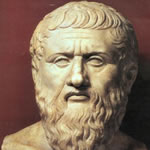
Fifteen years ago, when I first encountered Plato’s teachings at St. John’s College here, I railed against them. My mother used to call this, “Kicking against the pricks,” no pun intended.
Today I’m beginning to realize that this curriculum, based on the Great Books, a system devised in the 1940’s to encompass the whole of a gentleman’s essential library, reveals the base-the stones-on which we all stand.
The Stones We Stand On: Reading The Greeks

I’m trying, with a good deal of anxiety, to put together what I know and believe with the suppositions and proofs of the ancient Greek philosophers. They use a language and a way of thinking, totally abstract—almost—that is as foreign to me as the abstruse calculations each member of my class must write, from memory, on the blackboard.
The Dear Old-Or Not So Old-Atlantic Magazine

What a pleasure it is to see, in the midst of disheartening news about the low number of women writers whose writing appears in major national periodicals, that the Atlantic is at least at the top of the list.
On To The Next

Now that my newest book, Mending: New and Selected Short Stories is reaching its readers, I find myself in a rather delightful quandary.
The Blue and White Bandana
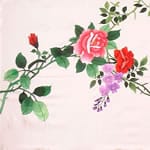
“Look at the embroidery,” she said, spreading out the bandana. Dense, tiny silk flowers in red, gold, purple and blue covered every inch.
“On the other side, too.” She turned it over; miraculously, it seemed to me, the wrong side of the bandana was also completely covered with tiny flowers. I’d been sewing letters on a sampler, much against my will, and I knew how messy the back side of anything embroidered usually looked.
She’s the Woman Wearing a Red Hat
Our books are expensive and employ language that is rapidly becoming obsolete. They are sold in bookstores, which are themselves, special, separate, threatened, and rare.
My Mother’s Eyes
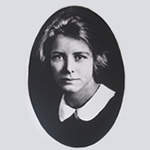
When I became aware of her as my mother (I was her third child), she was a tiny blond woman, almost doll-like, formed by the conventions of upper class marriage. I almost never saw her without make-up, her hair set in careful blond curls, wearing a powerful girdle, a suit and carrying a purse; she seemed always to be armed for a distant battle.
Knife, Dagger, Poignard

It glittered obscurely in the back of the curio cabinet my grandmother kept in her dark little house in Richmond, Virginia, the house where she’d raised six daughters and a son. On the walls there were snapshots of all those golden-haired girls, and the one dark-haired boy, as well as their equally fair children and grandchildren, but I don’t remember them. Familiar icons, alike in all houses, they were not interesting; but the curio cabinet, and its contents-which only my grandmother touched-alerted me instantly to the electric presence of stories.
Dorothy Parker, the Volney Hotel, New York in the 1960’s, and Me
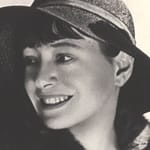
When I started out as a writer in the 1960’s, I had to go to New York. There was no alternative. Even Boston, where I lived for a few years after college, and which had an old literary tradition, wouldn’t do; the real publishers, agents, bookstores and readers were—they had to be!—in New York. I had no idea, really, what New York was like; I’d never lived there; and I couldn’t have predicted how hostile the environment would be to me.